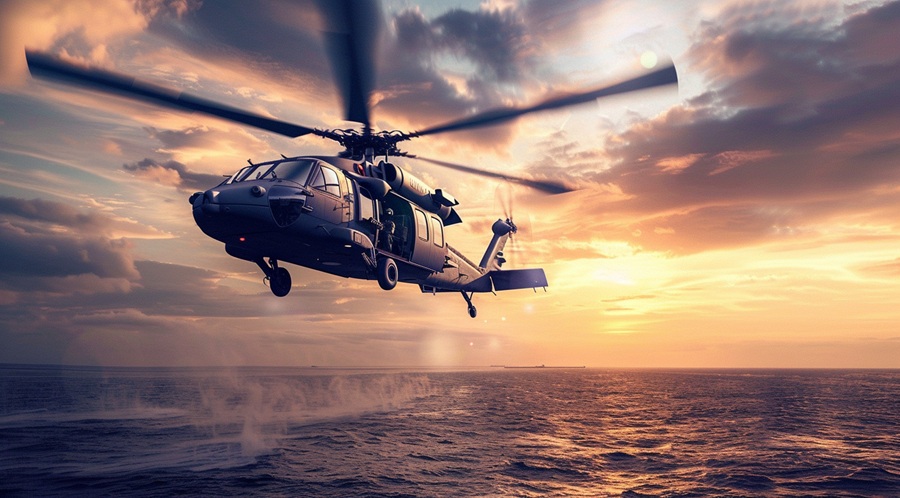
Helicopter
Japanese Name
へりこぷたー
herikoputaa
Description
- A helicopter is a type of aircraft that can take off, land, and hover vertically.
- It uses one or more horizontal rotors to generate lift and thrust.
- Unlike airplanes, helicopters don’t require a runway.
- They are capable of flying in multiple directions, including sideways and backward.
- This versatility makes them ideal for rescue, transport, and military missions.
- The main rotor provides lift, while a tail rotor (or other system) counteracts torque.
- Modern helicopters can fly at altitudes of several thousand feet.
- They are used in both civilian and military applications around the world.
History
- The concept of vertical flight dates back to ancient Chinese toys.
- Leonardo da Vinci sketched an early helicopter concept in the 15th century.
- The first practical helicopter was the Focke-Wulf Fw 61, flown in 1936.
- Igor Sikorsky, a Russian-American engineer, built the first successful mass-produced helicopter, the VS-300, in 1939.
- During World War II, helicopters were tested for medical evacuations and transport.
- They became widely used during the Korean and Vietnam Wars.
- Technological advances have improved speed, stability, and efficiency over the decades.
- Today, helicopters play critical roles in search-and-rescue, law enforcement, and offshore transport.
Learn more Japanese words?
Play our free typing game and master Hiragana & Vocabulary in a Zen atmosphere. 🍵
🎮 Play Game